Visualizzazione post con etichetta history. Mostra tutti i post

mercoledì 12 agosto 2009

I Want Candy (part I)

Just so you know.
I have an insane passion for sweets, candies, chocolates, cakes and sweet things in general.
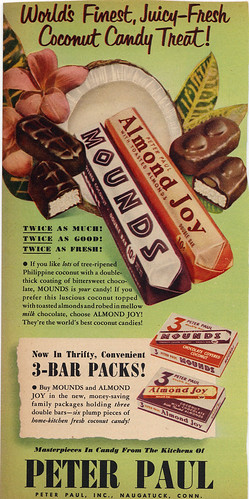
If I was shipwrecked on a desert island with only an unlimited supply of Nutella (presupponing that I was travelling on a tanker full of Ferrero products), I could survive 'till the end of the days, eating just Nutella forever, maybe just adding coconut for a spurious Bounty Bar.

Talking about Bounty Bars: did you know that their antecedents (Peter Paul's Coconut Mounds, Almond Joy) were introduced in the 1920s and became popular in the 1940s?
And that the Mars bar was created in 1932, and M&M's a few years later?
Can you imagine eating candy cigarettes (sometimes called sugar fags in the UK), colorful sweets named "Chuckles", disquieting "Long Boys" chocolates, funny Root Beer Barrels or squared, bright violet gums?
If you were children in the 40s and 50s, you'd have loved 'em.

I did a little research about vintage candies, and that's what I found out.

1940s


Sen-Sen was developed in the late 1800s by T.B. Dunn and Co., perfume dealers. In keeping with its perfumery roots, it was on the market list for many years as a cosmetic: Sen-Sen was to the 19th century what breath mints are to our time.


Any country store worth its salt prominently displayed a box of the handy little packets within easy reach of its customers.


Sugar Daddy was the biggest lollipop of its times.
The Sugar Daddy was originally called the Papa, and was invented in 1925 by a chemist named Frank at the James O. Welch Company. The name was changed to Sugar Daddy in 1932. Sugar Babies were introduced three years later, in 1935.


BB Bats were super hard, little taffy-like candy suckers, and you could get them in strawberry, banana, chocolate, and one other flavor that was sort of like peanut butter. They probably were supposed to be soft and chewable, and once in awhile they were, but most of the time you could build the foundation of a house out of them on account of they were so hard. Despite that, they were super popular, and you could get one for one or two cents max.
(article source: adzines.com)


Bit-O-Honey
first appeared in 1924, as a new kind of candy bar, consisting of six pieces of candy wrapped in wax paper, and then packaged in a wrapper.
The candy consisted of almond bits embedded in a honey-flavored taffy which makes for a long-chewing candy.
Practically, when you ate one of these, it would have left you tongue-tied and nearly unable to speak for at least an hour or two, unless you provided with an adequate quantity of water.


Salt Water Taffy
The real origins of how salt water taffy got its name are disputed. However, the most popular story concerns a candy-store owner, Mr. David Bradley, whose shop was flooded during a major storm in 1883. His entire stock of taffy was soaked with salty Atlantic Ocean water. When a young girl came into his shop and asked if he had any taffy for sale, he is said to have offered some "salt water taffy." It was a joke, because all his taffy had been soaked with salt water, but the girl was delighted, and she bought the candy. Mr. Bradley's mother was in the back and heard the exchange. She loved the name and so Salt Water Taffy was born.

venerdì 24 luglio 2009

The Lost Brigade


A little bit of history, today, dear readers of mine.
My family's one, actually.
But Italian history, too.

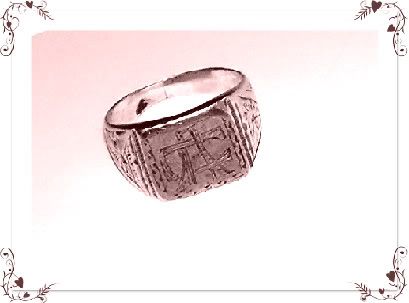
Let's start from that ring there: I wear it most of the time, wedging another ring into it to make it the right size - I have ridiculously small fingers, and it's way too big for me.
The ring in point was my grand-grandfather's, Anchise Cioni (The 'C' and 'A' in the front), who died in Greece during the WWII, lefting her wife Elena a widow and his two little daughters, Alberta (my granny) and Vanda, two orphans when they were babies, not even school-age.
Elena was sort of an unusual woman: born in the 1890s in a tiny village in North Italy (population oscillating between 50 souls when the times were florid, to a dozen when times became hard); daughter of farmers, she went to school - quite an eccentricity for a country where, at the time, 90% of people, and nearly 100% of women, were illiterate, - and learned to write and read; then she worked as a maiden for an influent family, whose members, for some funny unknown reason, used to call her "Lena".
She was no beauty, but she managed to marry Anchise, who was more than a handsome man, hiring him away from her much prettier sister; Anchise was named "The English" by friends because of his fair hair and eyes (uncommon in a country where 90% of people have a dark complexion) and tall height.
I inherited no height from him, but people say I have his hair and skin, freckles included.
Nothing is left of him (Even Elena's wedding ring, the only golden thing she'd ever had, was confiscated by the Fascist army to fund the war) except from some books, a blurry photography or two, and this ring - the only thing that won't become dust in a couple of decades.

The medal below has a more interesting story.
It was coined in Vienna in 1863, for the circa 3000 men who were part of the Brigata Estense, that is to say, the private army of Francesco V D'Este, Duke of Modena.
That name does not ring any bell?
Of course not.
It was a damn hard work to find out what the hell this "Brigata Estense" was.
Well, I finally found out that, in 1859, the Brigata Estense gave Garibaldi hell, and made the Italian Unity stagger for a while.
But, as we all know, history is written by the winner - and Garibaldi won, after all.
So, the Brigata fell into oblivion, and not many people even know it existed.
But this is its story.

June 11, 1859.
Sun has yet to rise when Francesco V, last Duke of Modena, jumps on his horse, hardly restraining emotion - a solemn departure that fits his romantic soul.
He has just been defeated by the Piedmontese army, and he has to abandon the city imediately, and for ever.
But he does not flee alone. He is the only sovereign who is followed by his army into exile.
Those soldiers follow him in Mantua for nothing else but devotion - the Duke is unable to pay them, luck is bad, and their future, more than precarious.
In addition to that, Garibaldi tries everything to convince them to come back: they're making a fool of him in front of his men, and in front of Austria. If the Duke is still in charge, the Italian Unity is in danger.
He tries to buy them, then to threaten them. But, for the following four years, those young men stay by Francesco's side.
He himself tries to convince them to go back home, not wanting them to be punished, or their families threatened.
He discharged the troops, but only 172 people, out of 3000, choose to go back. The others stay.
Meanwhile, about 1000 people come from Modena and ask to join the Brigata. The story of its courage and loyalty is spreading fastly through Italy.

But the destiny of the Brigata is doomed. In 1863 Francesco and his wife, Aldegonda - whose eyes are tear-filled, and who burst into tears before the ceremony is over - decorate every man with a medal, whose back beared a sentence.

Fidelitati et costantie in adversis.
Loyalty and constancy in adversity.
1863


And there I come into play.

About one year ago, I was ransacking my grandmother's attic looking for a mourning veil that was my grand-grandmother's, when I run into this little dusty metal disc. There and then, I though it was some old tin cork or something. When I found out it was a medal, and that old, I was sure it was some worthless modern reproduction. What a surprise when I asked an antique dealer for information, and he said that, being a fan of the Brigata story, he had been looking for a copy of it for nearly 20 years, and he offered to buy it from me!

I never found out who was the brave relative of me who followed his prince that morning of June 1859, but I have a feeling that he was Sante Cioni, my grand-grand-grand-grand-father, born in 1840, dead in 1927.
But, whoever he was, he had to be nearly my age when he left his home, his family and friends and maybe his fiancè, and everything he had, to go far and away for who knows how much time.

Once I made researches to build my family tree: I found out that four generations of people was born, and died, in the same mycroscopic village, Camatta; population: about 300 people in the 1850s (Wiki).

We, modern people, used as we are to travel here and there everytime we like to, probably don't understand what it was like, in 1859, to leave one's house for a place, Mantua, that was 70 km (44 miles) far: at the time, when everybody born and die in the same town, in the same house, and never see another place, in a whole life, it looked as distant as the moon.
But Sante, or whoever he was, left everything behind and followed his leader, on his feet, for 70 kilometers, and remained where his leader was - a foreign country, where everybody spoke German and stared at them as they were a crowd of country bumpkins - for more than four years.
I wonder if anyone, now, would even think about doing something like that.