Visualizzazione post con etichetta 1940s. Mostra tutti i post

mercoledì 14 luglio 2010

New haircut, pincurls and a boyfriend


Preface.
The last time I had bangs I was eight years old - no kidding.
You probably couldn't care less about it but - I assure you -, it was quite an important assumption to me.
I've always had a one-lenght cut, with super-straight, waist-long hair; quite boring, to say the truth. Last week, after realizing that the last time I had gone to a hairdresser's was in, uh, March 2009, and I could have easily won a competition for the best split ends, I decided to put an end to it - and I had my hair cut.
I went to the hairdresser, holding a sheet of paper - the diagram below - tight in my hand like a weapon, and I warned him not to deviate from it. Surprisingly - hairdressers never do exactly what you ask them to do; is a matter of principle - he followed it slavishly.
So, now, fourteen years later, I have bangs - and layered hair - again.


When I saw him cutting it, and four-inches long strands of hair falling in front of me, I honestly had a moment of panic - the "This-Is-The-Worst-Mistake-I've-Ever-Made" kind of thing - but I have to admit that, now that is done, I find it amazingly versatile.
I set my hair in pincurls for a night out, and the result pleased me a lot.
Here's me, makeup-less and glassy-eyed, with my bew haircut; and, just above, me in my vintage-inspired hairdo.


(Dress - gift; Bag - vintage 1950s, thrifted; Coral earrings, bracelet and necklace: vintage, thrifted; Hair flower - Ninetynine store)

Even my boyfriend liked the new cut, and greeted it with -- a bunch of her grandmother's roses! So cute!


mercoledì 2 dicembre 2009

Library finds, part II - Modern... Vintage!

For all those people who think "vintage" as a synonymous of "granny-like", I found out some photos that could make you change your mind... a little bit!
After another raid in the local library, I came home with, among others, a photograph book about Dior and another one about the great fashion designer Renè Gruau.
So, what? You could say.
They were both used to draw clothes in the 1940s-1950s: what's new about that?
Well, I noticed some similarities between a few different pictures; and I decided to ask you to play with me an old game: the kind of game you can find in the crossword magazines.
So... are you ready to find the differences between the photos I'll post below?


Look at this picture: this quirky, luscious red evening dress, named "Ispahan", was designed in 1947 by Gruau for - guess who? - Dior.
Ruby red silk, gloves, stiletto heels, pearls. A refined updo to let the model's bare shoulders uncovered.
Looks like a typical case of the mixture of elegance and craziness, malice and voluptuousness, that characterized French fashion in the early 1950s - no more financial straits, people long again for elegance, luxury, and some fun.
With its fancy bodice - red baroque roses emphasizing the bust, an equally red shawl around bare shoulders, this model is peculiar of its time - today, its rococo roses would appear dated and out of place.

... Or not?


This fire-red taffeta dress belongs to the Winter Collection 1989-1990.
A draped stole wraps the model showing its peculiarity: extravagant silk roses all around the shoulders, surrounding bare neck and shoulders, highlighted by a high chignon.

It's just me, or this dress reminds us of something we have already seen before...?


Same thing with these couples of photos: which one is following the other's exemple?


On the left: pattern from the 1940s.
On the right: model from the 90s.


On the left: Dior dress, 1950s.
On the right: Dior dress, late 1980s.


Now, take as well this picture, and its modern, offhand, jaunty feel.
When I first saw it, I could have bet it was made in the late 1980s: a bright pattern, high-waisted tight trousers, flat shoes.

Nothing further from the subdued colours, neatness and panache of the war and post-war times... If we ignore the fact the picture was drawn in the late 1940s for the cover of the International Textiles.

I found a slightly, but funny resemblance with some 1980s dresses I've seen on the net, like this, or this.


Let's take a last look on this one. This drawing is so amazingly up-to-date, with its comic strip look and a slightly 90s feel, that I was quite surprised it was actually made in 1957.
Nothing it its contrasting, bright colours, or essential and rough-edged lines, reminds me about the Fifties and the dreamy idea of a soft, kind-hearted femininity that it's usually associated with these years.
When I see this jazzy checked pattern, the first image that comes to my mind is more like this... than this!
... But, maybe - I should reassess my idea of what "vintage" is! :)

venerdì 20 novembre 2009

Library finds

As I promised, I'm trying to make the most of my car wreck, and I'm enjoying the newly found library section devoted to the history of fashion.
From a book called "Vestiti: lo stile degli italiani in un secolo di fotografie" ("Dresses: Italian style, a century of pictures"), here's a few of my favourites.

Look at this girl from 1935, looking amazingly modern in her plain, smooth, low-necked blouse and black pearl necklace, with an elegant silver fox fur around her shoulders and a malicious smile on her face.
Only her super thin, penciled eyebrows, a hint of finger waves, and her cloche hat point out her belonging to the 30s: had the picture been not dated, I could have thought it was taken yesterday.


Looking at those two elegant women, you could bet they were posing for the photographer - just waiting, in their best side, for the picture to be taken.
But, actually, this picture was taken at some horse racing in 1935-1936, and those ladies are actually following their front-runner with a tiny pair of field-glasses.
But look at the bucket purse the lady on the right is holding - or the belt the other one has wrapped around her waist, in contrast with the white, double-breasted jacket: didn't they look like they were modelling for some fashion designer?


How can I not love the casual, yet stylish jacket and matching culottes this girl wears in winter 1937?
The sobriety of her dress, anyway, is sweetened by the nice hat on her head, with its ducky ribbon bow.
According to the caption, she is a model showing a new kind of fabric; at the time, in Italy, there were more than 800 fashion houses.


This amazingly beautiful girl in the picture, dated 1945, is not the starlet of a forgotten Hollywood movie, but Marella Caracciolo Agnelli, the wife of Gianni Agnelli - The Lawyer, as they used to call him - the most well-known, much speculated-about Italian industrialist, the principal shareholder of Fiat (Agnelli was also known worldwide for his impeccable, slightly eccentric fashion sense).
She is still now one of the most influent patron of the arts in Italy - but she is also the daughter of a Duke... as her husband was the son of a princess.


It Italy, we say "Donne al volante, pericolo costante", that we can translate as "Woman driving, peril thriving"; or "Donne e motori, gioie e dolori", that is to say, " Women and engines, joys and pains".
Women and machinery do not mix?
It does not look like so, if we take a glance at this 1948 picture, where two gals smiles at each other through a 1100 Sport Fiat.

I think that, apart from the pleased expression the woman at the wheel is showing, the elegant lines of the car, and the stylish clothes of the ladies... match perfectly!

mercoledì 12 agosto 2009

I Want Candy (part I)

Just so you know.
I have an insane passion for sweets, candies, chocolates, cakes and sweet things in general.
If I was shipwrecked on a desert island with only an unlimited supply of Nutella (presupponing that I was travelling on a tanker full of Ferrero products), I could survive 'till the end of the days, eating just Nutella forever, maybe just adding coconut for a spurious Bounty Bar.

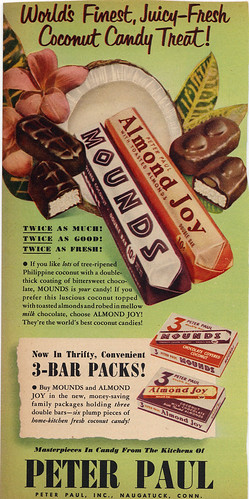
Talking about Bounty Bars: did you know that their antecedents (Peter Paul's Coconut Mounds, Almond Joy) were introduced in the 1920s and became popular in the 1940s?
And that the Mars bar was created in 1932, and M&M's a few years later?
Can you imagine eating candy cigarettes (sometimes called sugar fags in the UK), colorful sweets named "Chuckles", disquieting "Long Boys" chocolates, funny Root Beer Barrels or squared, bright violet gums?
If you were children in the 40s and 50s, you'd have loved 'em.

I did a little research about vintage candies, and that's what I found out.

1940s


Sen-Sen was developed in the late 1800s by T.B. Dunn and Co., perfume dealers. In keeping with its perfumery roots, it was on the market list for many years as a cosmetic: Sen-Sen was to the 19th century what breath mints are to our time.


Any country store worth its salt prominently displayed a box of the handy little packets within easy reach of its customers.


Sugar Daddy was the biggest lollipop of its times.
The Sugar Daddy was originally called the Papa, and was invented in 1925 by a chemist named Frank at the James O. Welch Company. The name was changed to Sugar Daddy in 1932. Sugar Babies were introduced three years later, in 1935.


BB Bats were super hard, little taffy-like candy suckers, and you could get them in strawberry, banana, chocolate, and one other flavor that was sort of like peanut butter. They probably were supposed to be soft and chewable, and once in awhile they were, but most of the time you could build the foundation of a house out of them on account of they were so hard. Despite that, they were super popular, and you could get one for one or two cents max.
(article source: adzines.com)


Bit-O-Honey
first appeared in 1924, as a new kind of candy bar, consisting of six pieces of candy wrapped in wax paper, and then packaged in a wrapper.
The candy consisted of almond bits embedded in a honey-flavored taffy which makes for a long-chewing candy.
Practically, when you ate one of these, it would have left you tongue-tied and nearly unable to speak for at least an hour or two, unless you provided with an adequate quantity of water.


Salt Water Taffy
The real origins of how salt water taffy got its name are disputed. However, the most popular story concerns a candy-store owner, Mr. David Bradley, whose shop was flooded during a major storm in 1883. His entire stock of taffy was soaked with salty Atlantic Ocean water. When a young girl came into his shop and asked if he had any taffy for sale, he is said to have offered some "salt water taffy." It was a joke, because all his taffy had been soaked with salt water, but the girl was delighted, and she bought the candy. Mr. Bradley's mother was in the back and heard the exchange. She loved the name and so Salt Water Taffy was born.